|
|
|
 Go to: TOC |
FOLLICULAR lymphomas are one of the more common non-Hodgkin lymphomas in North America. They afflict almost exclusively adults, particularly the middle-aged and elderly. Because the small-cleaved cells of follicular lymphomas know how to book passage in the blood, patients usually present with disseminated lymphadenopathy. Nonetheless these lymphomas are less aggressive than diffuse large-cell lymphomas and other higher grade lymphomas.
The follicular pattern must be distinguished from other benign and malignant nodular processes, including:
One of the more difficult morphologic distinctions in hematopathology can be between reactive follicular hyperplasias and follicular lymphomas. The important points include: |
|
|
||||||||||||||
|
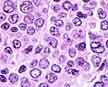
Grading Follicular Lymphomas Prior to the WHO classification, follicular lymphomas were divided into 3 types according to the ratio of small-cleaved to large cells: small-cleaved cell type, mixed small-cleaved and large cell type, and large cell type. In the WHO classification these distinctions have been abolished, because they seem to imply the existence of different disease subtypes. The authors of the WHO classification felt that all follicular lymphomas are instances of the same disease, but that the grade of the disease varies from case to case. This is similar to the concept behind grading other cancers, such as breast carcinomas. The authors of the WHO classification suggest that pathologists define "clinically relevant and reproducible criteria" for separating follicular lymphomas into 3 grades. They recommend in particular the "Berard" cell-counting method as tested in the literature, which emmumerates the number of large centroblasts per high-power field (hpf): Although generally the higher grade cases tend to behave more aggressively, the most important distinction is between, on the one hand, grade 1 and 2 cases and, on the other, grade 3 cases. This last group may require therapy that includes adriamycin in order forestall a tendency toward early relapse. In addition, high grade cases are less likely to have distinctive follicular features, such as expression of CD10 or the t(14;18) translocation involving Bcl-2. Another issue is how to respond to the presence of areas of diffuse growth in follicular lymphomas. Generally with grade 1 and 2 cases the amount of diffuse growth should be roughly quantified using the terms "predominantly follicular" (>75% follicular), "follicular and diffuse" (25-75% follicular), and "predominantly diffuse" (<25% follicular). Grade 3 follicular lymphomas are different, in that a diffuse area of centroblastic proliferation represents a component of diffuse large B-cell lymphoma; and the case must be reported as containing such a component.
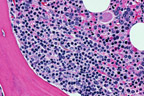
As with many cancers, follicular lymphomas tend to become more aggressive with time. The percentage of small-cleaved cells may decrease, and the nodularity may grow fainter or vanish. As the proportion of large cells increases, so does the mitotic rate, the tendency to grow diffusely, and the aggressiveness of the lymphoma. It may seem a little mysterious that follicular lymphomas can develop a diffuse growth pattern, but that is part of their malignant potential. As malignant follicular center cells begin to dedifferentiate, they lose their ability to ape the appearance and behavior of their normal counterparts. Treatment options depend on the stage and grade of the disease. The infrequent patients with early-stage disease may be treated with local radiation, with or without chemotherapy. Patients with more advanced but low-grade disease may remain untreated as long as no symptoms or lymphoma-related organ compromise are present. When treatment becomes necessary, the options include: 1) single-agent alkylator therapy; 2) low-intensity combined chemotherapy without an anthracycline; 3) whole-body irradiation. Patients with grade 3 follicular lymphoma may benefit from the inclusion of an anthracycline in their chemotherapy. Extranodal Involvement
Follicular lymphomas are reactive for pan-B-cell markers CD19, CD20, and CD22 in addition to expressing monoclonal light chains. Most cases also react for CD10, which is also seen in lymphoblastic lymphoma but not other low grade lymphomas. No staining for CD5 is seen. Most cases of follicular lymphoma, especially those rich in small-cleaved cells, have a t(14;18) translocation. This results in a rearranged and constitutively over-expressed gene called Bcl-2. The Bcl-2 gene product is an inner mitochondrial membrane protein that blocks apoptosis (in plain English, programmed cell death). Although this protein is produced by an unrearranged Bcl-2 gene in much benign lymphoid tissue and many lymphomas besides follicular ones, it is not detected in benign, reactive germinal center cells. Thus its presence, as detected by immunostaining, can differentiate malignant from benign follicles.

|